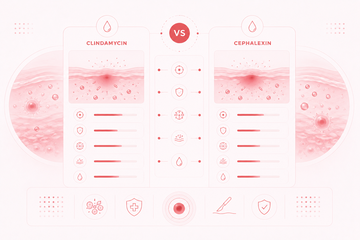
Clindamycin vs Cephalexin is an antibiotic comparison commonly discussed in relation to bacterial infections involving skin and soft tissue. Clindamycin is a lincosamide antimicrobial, whereas Cephalexin is a first-generation cephalosporin within the beta-lactam class. Their pharmacodynamic targets, susceptibility profiles, and antimicrobial spectra differ, creating distinct pharmacology contexts for infectious-disease analysis.
In a soft tissue infection overview, bacterial involvement may be associated with erythema, edema, tenderness, purulence, or other manifestations of an inflammatory response. Conditions such as cellulitis, abscess, and other skin-associated processes are often discussed according to anatomical depth, microbial burden, and organism susceptibility.
The Clindamycin vs Cephalexin comparison therefore extends beyond a simple drug-versus-drug description. Infectious-disease references commonly consider gram-positive organisms, selected gram-negative organisms, resistance mechanisms, tissue distribution, pharmacokinetics, and clinical classification when describing these antibiotics. This page presents those concepts neutrally, without dosing instructions or treatment recommendations.
Clindamycin and Cephalexin belong to distinct antimicrobial classes and therefore represent different pharmacological approaches to bacterial infection. Clindamycin is a lincosamide that acts primarily through inhibition of bacterial protein synthesis at the 50S ribosomal subunit. Cephalexin is a first-generation cephalosporin and beta-lactam whose antibacterial activity is associated with interference in peptidoglycan cell-wall synthesis. This class distinction is central to an antibiotic comparison because mechanism of action, resistance biology, pharmacokinetics, and susceptibility testing are interconnected. In infectious-disease references, both agents may be discussed in relation to infections involving susceptible gram-positive organisms, while their overall spectra are not identical.
The comparison becomes more specific when considered within a soft tissue infection overview. Clinical entities such as skin infection, cellulitis, and abscess may contain different microbial populations and inflammatory patterns. Erythema, edema, tenderness, purulence, and microbial burden can describe the infectious phenotype but do not independently establish organism identity. Clinicians may evaluate microbiological context, anatomical involvement, susceptibility data, inflammatory response, and pharmacological characteristics when interpreting how Clindamycin and Cephalexin differ. The comparison is therefore best understood as a structured pharmacology framework rather than a universal hierarchy between the two antibiotics.
| Characteristic | Clindamycin | Cephalexin |
|---|---|---|
| Antimicrobial class | Lincosamide | First-generation cephalosporin |
| Primary target | Bacterial protein synthesis | Bacterial cell-wall synthesis |
| Mechanistic category | Ribosomal inhibition | Beta-lactam cell-wall inhibition |
| Comparison context | Susceptible bacterial infections with relevant gram-positive activity | Susceptible bacterial infections with prominent gram-positive activity |
The pharmacology of Clindamycin and Cephalexin differs at the level of molecular target, antimicrobial mechanism, distribution, metabolism, and elimination. Clindamycin binds to the bacterial 50S ribosomal subunit and alters protein synthesis, placing it within a ribosome-directed pharmacodynamic category. Cephalexin belongs to the beta-lactam family and acts through binding to penicillin-binding proteins, disrupting bacterial cell-wall assembly. These mechanisms produce different relationships between bacterial growth, drug exposure, resistance determinants, and susceptibility measurements. Pharmacokinetics may also differ in absorption, tissue distribution, protein binding, biotransformation, and renal elimination, making pharmacological classification relevant when comparing the agents.
Within infectious-disease pharmacology, these differences are considered alongside the characteristics of the infection itself. A bacterial process involving the skin or soft tissues may contain a microbial burden influenced by tissue architecture, necrotic material, inflammation, vascular perfusion, or localized purulence. Infected wounds and soft tissue infections are therefore useful contexts for discussing how antimicrobial pharmacology intersects with anatomical compartments. Clinicians may evaluate susceptibility patterns and organism identity because resistance mechanisms can alter the relationship between an antibiotic's intrinsic activity and observed microbiological susceptibility. Often discussed in infectious-disease references, the comparison between Clindamycin and Cephalexin consequently includes mechanism, exposure, distribution, bacterial target, resistance biology, and infection-site characteristics rather than drug class alone.
| Pharmacology feature | Clindamycin | Cephalexin |
|---|---|---|
| Target | 50S bacterial ribosomal subunit | Penicillin-binding proteins |
| Primary mechanism | Protein synthesis inhibition | Interference with cell-wall synthesis |
| Drug class | Lincosamide | Beta-lactam cephalosporin |
| Pharmacokinetic considerations | Absorption, distribution, hepatic metabolism, and elimination | Absorption, distribution, and predominantly renal elimination |
Spectrum differences are a central component of the Clindamycin vs Cephalexin comparison. Clindamycin commonly demonstrates activity against numerous susceptible gram-positive organisms and selected anaerobic bacteria, although susceptibility varies by species and geographic resistance patterns. Cephalexin is commonly associated with activity against susceptible gram-positive organisms and selected gram-negative organisms, but its spectrum also remains dependent on bacterial species and resistance mechanisms. The terms gram-positive organisms and gram-negative organisms describe broad microbiological categories rather than fixed predictions of susceptibility. Infectious-disease references therefore distinguish intrinsic spectrum from the susceptibility phenotype of an individual isolate.
Resistance mechanisms further complicate spectrum interpretation. Clindamycin susceptibility can be influenced by macrolide-lincosamide-streptogramin resistance mechanisms, including inducible resistance in relevant organisms. Cephalexin activity can be affected by beta-lactamases and other mechanisms that alter beta-lactam susceptibility. In contexts such as MRSA or MSSA, organism classification can therefore materially change how an antibiotic comparison is described. Skin and soft tissue entities such as folliculitis, impetigo, and cellulitis may involve different bacterial populations. Clinicians may evaluate culture data and susceptibility patterns when those data are available, while the pharmacological comparison remains distinct from individualized treatment selection.
| Spectrum factor | Clindamycin | Cephalexin |
|---|---|---|
| Gram-positive organisms | Broad relevance among susceptible organisms | Prominent relevance among susceptible organisms |
| Gram-negative organisms | Limited and species-dependent activity | Activity against selected susceptible organisms |
| Anaerobic organisms | Relevant activity against selected susceptible anaerobes | Limited anaerobic spectrum |
| Resistance context | MLS resistance and inducible resistance mechanisms may matter | Beta-lactamase and other beta-lactam resistance mechanisms may matter |
Soft tissue infection provides an important anatomical context for comparing Clindamycin and Cephalexin because bacterial involvement can range from superficial skin processes to deeper connective-tissue compartments. Commonly described manifestations include erythema, edema, tenderness, warmth, purulence, and localized inflammatory response. These findings represent host-pathogen interaction rather than a direct identification of the responsible microorganism. Skin infection, abscess, cellulitis, and infected wounds may differ substantially in tissue architecture, microbial burden, and degree of localized inflammation.
The microbial context can include gram-positive organisms, gram-negative organisms, anaerobic bacteria, or mixed microbial populations depending on the anatomical setting and infectious process. Clindamycin's spectrum and resistance profile differ from those of Cephalexin, so the same clinical category does not automatically imply equivalent microbiological coverage. Often discussed in infectious-disease references, an antibiotic comparison considers the likely organism class, susceptibility phenotype, infection depth, tissue environment, inflammatory response, and presence of purulence or necrotic material. Clinicians may evaluate these factors as part of infectious-disease classification. The comparison should therefore remain contextual: the names of the antibiotics describe pharmacological properties, while the characteristics of the infection determine which microbiological questions are relevant.
| Soft tissue feature | Infectious-disease relevance | Comparison implication |
|---|---|---|
| Erythema and edema | Reflect localized inflammatory response | Do not independently establish bacterial species |
| Purulence | May indicate localized microbial burden and inflammatory material | May alter the microbiological context of comparison |
| Tenderness | Common inflammatory manifestation | Provides anatomical context rather than susceptibility data |
| Tissue depth | Distinguishes superficial from deeper involvement | Influences interpretation of infection-site pharmacology |
Dosing concepts form part of antibiotic pharmacology but are distinct from antimicrobial spectrum and should not be interpreted as a universal numerical formula. For Clindamycin and Cephalexin, dosing frameworks may vary according to formulation, route of administration, age category, organ function, infection classification, severity, and pharmacokinetic considerations. The relevant pharmacological concepts include dose selection, administration interval, route, formulation, exposure, absorption, distribution, metabolism, and elimination. These variables are generally discussed in relation to the drug's pharmacokinetic and pharmacodynamic profile rather than as isolated numerical values.
In a soft tissue infection context, antimicrobial exposure is also considered in relation to the anatomical site and microbial susceptibility. A soft tissue dosing reference may describe formulation-specific concepts, while side-effect, allergy, and contraindication information represents separate pharmacological dimensions. Clindamycin and Cephalexin differ in class, metabolism, elimination, and resistance biology, so their dosing concepts cannot be treated as interchangeable. Often discussed in infectious-disease pharmacology, dosing is therefore contextualized by patient factors, infection characteristics, formulation, susceptibility, organ function, and pharmacokinetic exposure. This section intentionally describes the conceptual framework without numerical dosing or clinical instructions.
| Dosing concept | Pharmacological relevance | Comparison consideration |
|---|---|---|
| Route | Determines how systemic or local exposure is established | Formulation and infection context can differ |
| Administration interval | Influences exposure over time | Depends on pharmacokinetic characteristics |
| Organ function | May affect drug disposition | Relevance differs between antimicrobial agents |
| Formulation | Influences absorption and exposure | Clindamycin and Cephalexin formulations are not pharmacologically identical |
Clinical interpretation of Clindamycin vs Cephalexin involves integrating microbiology, pharmacology, anatomy, and inflammatory phenotype. Microbial burden describes the quantity and distribution of organisms or microbial material within an infected site, while susceptibility describes the relationship between an organism and a particular antimicrobial under defined testing conditions. Erythema, edema, tenderness, warmth, purulence, and inflammatory response provide information about host-pathogen interaction but do not independently determine antimicrobial susceptibility. These distinctions are commonly described in infectious-disease references because clinical appearance and microbiological identity represent related but separate dimensions.
The anatomical diagnosis also influences interpretation. Soft tissue infection, skin infection, cellulitis, and abscess can represent different infectious patterns, while deeper extension may involve structures beyond the superficial tissues. Organism classification, including gram-positive and gram-negative categories, can provide additional context, as can resistance phenotypes such as MRSA or MSSA. Clinicians may evaluate microbiological evidence, infection depth, inflammatory findings, susceptibility patterns, host factors, pharmacokinetics, and potential adverse-effect considerations. The resulting framework is not a simple ranking of Clindamycin against Cephalexin; it is an assessment of how two distinct antimicrobial pharmacologies relate to a specific infectious-disease context.
| Interpretation factor | What it represents | Relevance to comparison |
|---|---|---|
| Microbial burden | Amount and distribution of microbial material | Adds context to infection intensity and anatomy |
| Susceptibility | Laboratory relationship between organism and antimicrobial | Helps distinguish theoretical spectrum from observed activity |
| Inflammatory response | Host response expressed through local or systemic findings | Describes phenotype without directly identifying susceptibility |
| Infection depth | Anatomical extent of infectious involvement | Influences interpretation of tissue and pharmacological context |
A Clindamycin vs Cephalexin comparison examines two antibiotics from different pharmacological classes. Clindamycin is a lincosamide that inhibits bacterial protein synthesis, while Cephalexin is a beta-lactam cephalosporin associated with inhibition of bacterial cell-wall synthesis. The comparison commonly includes antimicrobial spectrum, susceptibility patterns, resistance mechanisms, pharmacokinetics, and relevance to particular infectious-disease classifications.
An antibiotic comparison implies analysis of drug class, molecular target, pharmacodynamics, pharmacokinetics, antimicrobial spectrum, resistance mechanisms, and susceptibility. It does not mean that two agents are interchangeable or that one universally ranks above another. Infectious-disease references commonly place antibiotic properties within the context of organism identity, microbial burden, anatomical site, inflammatory response, and established microbiological classification.
Clindamycin and Cephalexin have overlapping but distinct antimicrobial spectra. Clindamycin commonly has important activity against susceptible gram-positive organisms and selected anaerobic bacteria. Cephalexin is associated with susceptible gram-positive organisms and selected gram-negative organisms. Actual susceptibility varies by bacterial species and resistance mechanism, so spectrum descriptions represent pharmacological categories rather than universal predictions for individual isolates.
Gram-positive and gram-negative classification provides a broad microbiological framework for comparing Clindamycin and Cephalexin. Their activity profiles differ across these organism groups, and susceptibility remains species-specific. Gram-positive organisms occupy an important part of both agents' pharmacological discussions, whereas gram-negative coverage differs. Infectious-disease interpretation therefore considers organism identity and susceptibility rather than relying only on broad bacterial classification.
Susceptibility patterns indicate how a bacterial isolate behaves in relation to a particular antimicrobial under defined laboratory conditions. They are important because intrinsic antimicrobial spectrum does not guarantee susceptibility in an individual organism. Resistance mechanisms can alter expected activity, particularly among organisms with established resistance phenotypes. Consequently, infectious-disease references commonly distinguish theoretical spectrum, observed susceptibility, and epidemiological resistance patterns.
Clindamycin and Cephalexin differ in molecular target, antimicrobial class, mechanism, metabolism, elimination, and resistance biology. Clindamycin acts at the bacterial ribosome and inhibits protein synthesis, whereas Cephalexin is a beta-lactam that interferes with cell-wall synthesis. Their pharmacokinetic profiles also differ, including drug disposition and elimination characteristics. These distinctions form a central part of pharmacological comparison.
Infection context matters because bacterial populations, anatomical compartments, microbial burden, inflammatory response, and susceptibility patterns vary among infectious diseases. A soft tissue infection may differ from another bacterial process in depth, organism distribution, purulence, and tissue environment. Clindamycin and Cephalexin have different pharmacological properties, so their comparison is more meaningful when related to the microbiological and anatomical characteristics of the infection.
Classification context connects antimicrobial pharmacology with the infectious-disease entity being described. Terms such as skin infection, soft tissue infection, cellulitis, abscess, gram-positive infection, and resistant bacterial phenotype identify different clinical or microbiological categories. Clindamycin vs Cephalexin analysis can then be organized around organism identity, susceptibility, anatomical involvement, inflammatory findings, pharmacokinetics, and resistance mechanisms rather than treating antibiotic comparison as an isolated concept.