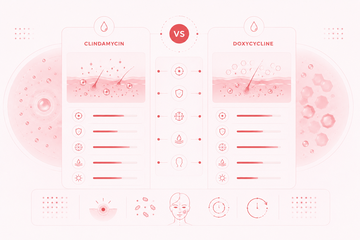
Clindamycin vs Doxycycline is an antibiotic comparison commonly discussed in infectious-disease pharmacology, particularly when bacterial skin infection and soft tissue involvement are considered. Clindamycin and Doxycycline belong to different antimicrobial classes and have distinct molecular targets, pharmacokinetic characteristics, and susceptibility profiles. Their comparison provides a framework for understanding how antibacterial activity relates to microbial classification.
A skin infection overview may include conditions involving superficial skin structures, hair follicles, localized collections, or surrounding soft tissue. Patterns such as erythema, edema, tenderness, purulence, and inflammatory response can accompany bacterial involvement, while microbial burden and organism susceptibility contribute to the broader infectious-disease context. Related patterns are also discussed in skin infection and soft tissue infection references.
Clindamycin vs Doxycycline does not represent a universal equivalence between antibiotics. Clindamycin is a lincosamide, whereas Doxycycline is a tetracycline-class antimicrobial. Their differences include ribosomal binding sites, activity against selected gram-positive and gram-negative organisms, resistance mechanisms, tissue distribution, and adverse-effect profiles. These pharmacologic distinctions are often discussed alongside conditions such as abscess, folliculitis, and cellulitis.
Clindamycin and Doxycycline are commonly compared because both are antibacterial agents with activity against selected organisms associated with skin and soft tissue infection, yet they represent different antimicrobial classes and pharmacologic mechanisms. Clindamycin is a lincosamide whose primary antibacterial action involves the 50S ribosomal subunit, producing inhibition of bacterial protein synthesis. Doxycycline belongs to the tetracycline class and acts primarily at the 30S ribosomal subunit, limiting incorporation of aminoacyl-tRNA into the growing peptide chain. These molecular distinctions form an important basis for an antibiotic comparison because resistance mechanisms, organism susceptibility, and pharmacodynamic behavior may differ between the two agents. A bacterial infection overview therefore considers the organism rather than treating the two drugs as interchangeable pharmacologic entities.
In infectious-disease references, comparative interpretation may also incorporate the anatomical and microbiological setting. A localized skin process, follicular infection, abscess-associated infection, or broader soft tissue process can involve different microbial populations and inflammatory patterns. Erythema, edema, tenderness, purulence, and surrounding inflammatory response describe host-tissue manifestations rather than establishing antimicrobial susceptibility by themselves. Microbial burden can further vary according to lesion structure, tissue depth, biofilm characteristics, necrotic material, or polymicrobial composition. Related patterns are commonly discussed through skin infection, soft tissue infection, abscess, and infected wounds terminology.
The comparison also includes distinctions in pharmacokinetics, tissue distribution, metabolism, elimination, drug interactions, and adverse-effect profiles. Clindamycin has comparatively important associations with gastrointestinal adverse effects and antibiotic-associated colitis, while Doxycycline has characteristic class-related gastrointestinal, photosensitivity, and esophageal adverse-effect considerations. These properties do not determine organism susceptibility but contribute to the broader pharmacology profile. Clinicians may evaluate such characteristics together with microbiological data, resistance phenotypes, infection classification, and anatomical context. The resulting comparison is therefore multidimensional rather than a simple ranking of one antibiotic against another.
| Characteristic | Clindamycin | Doxycycline |
|---|---|---|
| Antimicrobial class | Lincosamide | Tetracycline |
| Primary ribosomal target | 50S bacterial ribosomal subunit | 30S bacterial ribosomal subunit |
| Core pharmacologic action | Inhibition of bacterial protein synthesis | Interference with aminoacyl-tRNA attachment |
| Comparison relevance | Notable gram-positive and anaerobic activity with organism-specific limitations | Broad activity across selected gram-positive, gram-negative, and atypical organisms |
| Resistance consideration | Macrolide-lincosamide-streptogramin resistance mechanisms may be relevant | Tetracycline resistance mechanisms may alter susceptibility |
The pharmacology differences between Clindamycin and Doxycycline begin with their molecular targets and antimicrobial classes. Clindamycin binds to the bacterial 50S ribosomal subunit, with inhibition of protein synthesis associated with suppression of peptide-chain elongation. Doxycycline binds to the 30S ribosomal subunit and interferes with aminoacyl-tRNA access to the bacterial messenger RNA-ribosome complex. Both therefore affect bacterial protein synthesis, but they engage different ribosomal structures and belong to separate pharmacologic families. These distinctions can influence bacterial susceptibility, resistance pathways, spectrum characteristics, and pharmacodynamic interpretation.
Pharmacokinetics provides another major comparison domain. Clindamycin undergoes substantial hepatic metabolism and has active distribution into many tissues, while Doxycycline is characterized by extensive tissue distribution, high lipid solubility, and a comparatively distinctive elimination profile within the tetracycline class. Protein binding, gastrointestinal absorption, tissue concentrations, hepatic transformation, renal contribution, and drug-interaction potential may vary between the agents. Such characteristics are often discussed in pharmacology references without implying that one profile is universally preferable. The relevance of these properties depends on the organism, anatomical compartment, microbial burden, inflammatory environment, and concurrent clinical factors.
Resistance biology further differentiates the two agents. Clindamycin susceptibility can be affected by inducible or constitutive resistance involving methylation of the ribosomal target, particularly within the broader macrolide-lincosamide-streptogramin resistance group. Doxycycline susceptibility can be altered by mechanisms such as ribosomal protection and active efflux. Consequently, susceptibility testing may provide information that cannot be inferred from bacterial morphology or inflammatory appearance alone. In infectious-disease interpretation, pharmacokinetics and pharmacodynamics are therefore considered alongside organism identification, resistance phenotype, tissue location, and the clinical classification of the infection.
| Pharmacology feature | Clindamycin | Doxycycline |
|---|---|---|
| Drug class | Lincosamide | Tetracycline |
| Ribosomal binding site | 50S | 30S |
| Protein synthesis effect | Suppresses peptide-chain elongation | Disrupts aminoacyl-tRNA attachment |
| Major metabolic characteristic | Predominantly hepatic metabolism | Distinctive tetracycline pharmacokinetic profile with substantial tissue distribution |
| Resistance mechanisms | Target-site modification and inducible or constitutive MLSB resistance | Efflux and ribosomal protection mechanisms |
Spectrum differences are central to the Clindamycin vs Doxycycline comparison because antimicrobial activity is organism-dependent rather than defined solely by the drug class. Clindamycin is commonly associated with activity against many susceptible gram-positive cocci and a range of anaerobic bacteria, while its activity against gram-negative aerobic organisms is limited. Doxycycline has a broader and more heterogeneous spectrum that can include selected gram-positive organisms, gram-negative organisms, atypical bacteria, and several intracellular pathogens. Neither spectrum should be interpreted as universal because susceptibility patterns vary by species and resistance phenotype.
Within bacterial skin infection, organisms such as Staphylococcus aureus and streptococcal species may be discussed in relation to both agents, but local resistance patterns can materially change the interpretation. Methicillin-sensitive Staphylococcus aureus, methicillin-resistant Staphylococcus aureus, and other resistant phenotypes may display different susceptibility patterns. Related infectious-disease concepts are discussed in MRSA and MSSA contexts. The presence of purulence, abscess formation, or cellulitic inflammation can describe the clinical phenotype without independently establishing whether Clindamycin or Doxycycline retains activity against the causative organism.
Anaerobic coverage represents another meaningful distinction. Clindamycin has recognized activity against many anaerobic organisms, whereas Doxycycline is not generally characterized by the same anaerobic spectrum. Conversely, Doxycycline has activity against certain organisms and pathogen groups that are not central to the traditional Clindamycin spectrum. Infectious-disease references therefore emphasize susceptibility testing, organism identification, resistance mechanisms, epidemiologic context, and anatomical site when comparing antimicrobial spectra. Spectrum is best understood as a probabilistic microbiological characteristic rather than an absolute label.
| Spectrum domain | Clindamycin | Doxycycline |
|---|---|---|
| Gram-positive organisms | Activity against many susceptible gram-positive cocci | Activity against selected gram-positive organisms, including some resistant phenotypes |
| Gram-negative organisms | Limited activity among aerobic gram-negative organisms | Activity against selected gram-negative organisms |
| Anaerobic organisms | Important activity against many susceptible anaerobic bacteria | More limited and organism-dependent anaerobic activity |
| Atypical or intracellular organisms | Limited role within its traditional spectrum | Activity against several atypical and intracellular pathogen groups |
| Resistance relevance | MLSB resistance may substantially affect susceptibility | Tetracycline resistance may substantially affect susceptibility |
A skin infection overview places antibiotic comparison within a spectrum of anatomical and microbiological syndromes. Bacterial skin infection can involve the epidermis, dermis, hair follicles, subcutaneous tissue, or connected soft tissue compartments. Commonly described patterns include follicular inflammation, cellulitic inflammation, localized abscess formation, infected wounds, and mixed superficial-deep tissue involvement. Erythema, edema, warmth, tenderness, purulence, crusting, drainage, or regional inflammatory response can accompany these syndromes, but visible morphology does not independently establish microbial identity. The infectious-disease classification therefore depends on anatomy, organism, inflammatory phenotype, tissue depth, and microbiological evidence.
Clindamycin vs Doxycycline may be discussed particularly in relation to bacterial skin and soft tissue infections involving Staphylococcus aureus or selected streptococcal organisms. However, susceptibility can vary substantially between methicillin-sensitive and methicillin-resistant isolates, and local epidemiology can alter the frequency of resistance phenotypes. Conditions such as abscess, cellulitis, folliculitis, and infected wounds represent different clinical patterns rather than interchangeable diagnostic categories. A purulent lesion may have a different microbial context from diffuse non-purulent inflammation even when both occur within the broader category of skin infection.
Soft tissue interaction also matters because infection may extend beyond the visible cutaneous lesion. Inflammation can involve subcutaneous fat, fascia, or adjacent structures, and microbial burden may vary with tissue oxygenation, necrotic material, foreign material, drainage characteristics, or polymicrobial composition. Anaerobic organisms may become relevant in selected anatomical contexts, while resistant gram-positive organisms may influence susceptibility interpretation. These distinctions connect the pharmacology comparison with broader soft tissue infection and anaerobic infection classifications without converting an anatomical description into an automatic antimicrobial conclusion.
| Skin infection pattern | Typical infectious-disease features | Comparison relevance |
|---|---|---|
| Follicular infection | Inflammation centered around hair follicles with variable bacterial involvement | Organism identity and susceptibility may influence interpretation |
| Cellulitic inflammation | Diffuse erythema, edema, warmth, and tenderness involving skin and subcutaneous tissue | Microbial context may differ from localized purulent disease |
| Abscess-associated infection | Localized collection with purulence and surrounding inflammatory response | Microbial burden and organism susceptibility may be important |
| Infected wound | Disrupted barrier with bacterial contamination and variable tissue involvement | Polymicrobial and resistant-organism considerations may arise |
| Mixed soft tissue involvement | Inflammation extending beyond superficial skin structures | Anatomical depth can alter infectious-disease classification |
Dosing concepts in an antibiotic comparison describe how pharmacokinetic and pharmacodynamic properties are translated into an individualized medication regimen, without treating dosing as a universal constant. Clindamycin and Doxycycline differ in formulation, absorption characteristics, tissue distribution, metabolism, elimination, drug interactions, and pharmacodynamic behavior. These differences mean that a comparison based only on milligram amounts would not accurately represent pharmacologic exposure. Relevant concepts include formulation, route, bioavailability, dosing interval, tissue penetration, protein binding, hepatic metabolism, renal contribution, and the relationship between exposure and antimicrobial activity.
Infectious-disease pharmacology also considers the anatomical site and microbial burden when interpreting dosing concepts. A superficial skin process may present a different pharmacokinetic context from deeper soft tissue involvement, while an abscess, infected wound, or polymicrobial lesion can introduce additional microbiological variables. References describing soft tissue dosing concepts can be considered alongside broader pharmacology terminology, while related information may also involve side effects, allergy, and contraindications. These categories describe factors that influence medication selection and interpretation rather than providing a universal regimen.
Formulation can also influence pharmacologic interpretation. Clindamycin and Doxycycline may be available in different pharmaceutical forms depending on jurisdiction and product, and formulation characteristics can affect administration route, absorption, and exposure. Dosage concepts therefore belong to a broader pharmacokinetic framework that includes patient-specific characteristics, organ function, interacting medicines, infection site, organism susceptibility, and inflammatory state. Clinicians may evaluate these variables when interpreting an antibiotic comparison, while infectious-disease references commonly separate pharmacologic principles from individualized prescribing decisions.
| Dosing concept | Clindamycin | Doxycycline |
|---|---|---|
| Formulation considerations | Multiple formulation types may alter pharmacologic handling | Multiple formulation types may alter pharmacologic handling |
| Bioavailability | Route and formulation influence systemic exposure | Route and formulation influence systemic exposure |
| Distribution | Broad tissue distribution with variable compartment concentrations | Extensive tissue distribution influenced by lipophilicity |
| Metabolism and elimination | Predominantly hepatic metabolism | Distinctive tetracycline elimination profile with limited renal dependence relative to some tetracyclines |
| Individualization factors | Organ function, interactions, infection site, susceptibility, and adverse-effect considerations | Organ function, interactions, infection site, susceptibility, and adverse-effect considerations |
Clinical interpretation of Clindamycin vs Doxycycline involves integrating microbiology with anatomy and inflammatory phenotype. Organism identification, susceptibility testing, resistance mechanisms, microbial burden, tissue depth, and local epidemiology may all influence how an antibiotic comparison is understood. Gram-positive organisms, gram-negative organisms, anaerobic bacteria, and atypical pathogens have different intrinsic susceptibility characteristics, while acquired resistance can modify expected activity within a species. Consequently, the presence of erythema, edema, tenderness, purulence, or drainage describes an inflammatory phenotype but does not independently establish which antimicrobial has activity against the causative organism.
The distinction between purulent and non-purulent disease can also affect infectious-disease classification. Purulent lesions may be associated with localized microbial collections and substantial microbial burden, whereas diffuse non-purulent inflammation may involve different tissue architecture and organism patterns. A skin infection can coexist with an abscess, follicular infection, wound infection, or broader soft tissue involvement, creating overlapping clinical terminology. These relationships are often discussed in skin infection, abscess, cellulitis, and infected wounds references.
Pharmacologic interpretation also includes adverse-effect profiles, allergy history, contraindication categories, drug interactions, formulation characteristics, and patient-specific pharmacokinetics. Clindamycin has distinctive gastrointestinal and antibiotic-associated colitis considerations, while Doxycycline has class-specific gastrointestinal, photosensitivity, and developmental considerations. These factors do not replace microbiological susceptibility but contribute to the overall pharmacology context. Clinicians may evaluate the relationship among organism, anatomical site, microbial burden, inflammatory response, pharmacokinetics, and resistance phenotype when interpreting comparative antibiotic information.
| Interpretation factor | Infectious-disease relevance | Comparison significance |
|---|---|---|
| Organism identification | Defines the microbial category under consideration | Determines whether intrinsic or acquired susceptibility patterns are relevant |
| Susceptibility | Reflects measured or inferred antimicrobial activity | Can distinguish apparent spectrum from actual isolate-level susceptibility |
| Microbial burden | Describes the quantity and distribution of organisms within infected tissue | May affect pharmacodynamic interpretation and tissue context |
| Inflammatory response | Includes erythema, edema, tenderness, purulence, and related findings | Describes host response rather than directly proving antimicrobial susceptibility |
| Anatomical depth | Separates superficial skin involvement from deeper soft tissue disease | May alter pharmacokinetic and microbiological interpretation |
| Resistance phenotype | Identifies acquired mechanisms that reduce antimicrobial activity | Can materially change the comparison between Clindamycin and Doxycycline |
Clindamycin vs Doxycycline comparison describes the pharmacologic and microbiological differences between two antibacterial agents from separate drug classes. Clindamycin is a lincosamide acting primarily at the 50S ribosomal subunit, whereas Doxycycline is a tetracycline acting at the 30S subunit. Comparison commonly includes spectrum, susceptibility, resistance mechanisms, pharmacokinetics, tissue distribution, adverse-effect profiles, and infection context.
An antibiotic comparison places antimicrobial agents within a bacterial infection overview by examining organism susceptibility, antimicrobial class, molecular target, spectrum, pharmacokinetics, and resistance mechanisms. It does not mean that two antibiotics have identical activity or interchangeable pharmacology. Infectious-disease references commonly distinguish gram-positive organisms, gram-negative organisms, anaerobic bacteria, resistance phenotypes, anatomical sites, and microbial burden when interpreting comparative information.
Clindamycin and Doxycycline have overlapping but distinct antimicrobial spectra. Clindamycin is commonly associated with susceptible gram-positive organisms and many anaerobic bacteria, while aerobic gram-negative activity is limited. Doxycycline has activity against selected gram-positive and gram-negative organisms, as well as several atypical and intracellular pathogens. Actual susceptibility remains organism-specific and can be altered by acquired resistance mechanisms.
Gram-positive and gram-negative classification reflects fundamental bacterial structural differences that can influence antimicrobial susceptibility. Clindamycin is more closely associated with selected gram-positive and anaerobic organisms, whereas Doxycycline has activity across a more heterogeneous collection of gram-positive, gram-negative, and atypical organisms. These broad categories do not establish isolate-level susceptibility, because species-specific and acquired resistance mechanisms remain important.
Susceptibility patterns indicate whether a particular bacterial isolate is inhibited by an antimicrobial under standardized testing conditions. Clindamycin susceptibility can be influenced by macrolide-lincosamide-streptogramin resistance mechanisms, while Doxycycline susceptibility can be altered by tetracycline resistance mechanisms such as efflux or ribosomal protection. Consequently, the theoretical spectrum of either antibiotic may differ from the susceptibility profile of a specific organism.
Clindamycin and Doxycycline differ in antimicrobial class, ribosomal target, metabolism, tissue distribution, protein binding, drug interactions, and adverse-effect profile. Clindamycin acts at the 50S ribosomal subunit and undergoes substantial hepatic metabolism. Doxycycline acts at the 30S ribosomal subunit and has extensive tissue distribution with a distinctive tetracycline pharmacokinetic profile. These characteristics contribute to their different pharmacologic identities.
Infection context matters because bacterial skin and soft tissue diseases can differ in anatomy, microbial burden, organism composition, inflammatory phenotype, and resistance prevalence. A localized purulent lesion may have a different microbial context from diffuse non-purulent inflammation. Factors such as abscess formation, cellulitic changes, infected wounds, tissue depth, and organism susceptibility can therefore change how Clindamycin and Doxycycline are interpreted.
Infectious-disease classification organizes infections according to anatomical site, microbial cause, inflammatory phenotype, tissue depth, and other defining characteristics. Clindamycin vs Doxycycline belongs within pharmacologic interpretation rather than disease classification itself. A skin infection may involve gram-positive organisms, gram-negative organisms, anaerobic bacteria, or resistant phenotypes, and the resulting classification provides context for understanding susceptibility, microbial burden, pharmacokinetics, and antimicrobial spectrum.