Antibiotic Comparison • Bacterial Infection Overview

Clindamycin vs Amoxicillin: Antibiotic Comparison

Clindamycin vs Amoxicillin is an antibiotic comparison involving two antibacterial agents from different pharmacological classes. Clindamycin is a lincosamide associated primarily with inhibition of bacterial protein synthesis, whereas Amoxicillin is an aminopenicillin beta-lactam associated with inhibition of bacterial cell-wall synthesis. Their distinct molecular targets create important differences in pharmacology, antibacterial spectrum, resistance mechanisms, and susceptibility patterns.

A bacterial infection overview may consider gram-positive organisms, selected gram-negative organisms, anaerobic bacteria, microbial burden, resistance phenotypes, and the anatomical environment where bacterial growth occurs. Respiratory conditions such as sinus infection, strep throat, and tonsillitis illustrate how pathogen distribution can affect interpretation of an antibiotic comparison.

Infectious-disease pharmacology also considers tissue penetration, pharmacokinetics, pharmacodynamics, inflammatory response, and local susceptibility patterns. Associations with soft tissue infection and skin infection provide additional contexts in which Clindamycin and Amoxicillin may display different microbiological and pharmacological characteristics. This page presents those differences neutrally without dosing instructions or clinical recommendations.

Antibiotic Comparison Overview: Clindamycin vs Amoxicillin
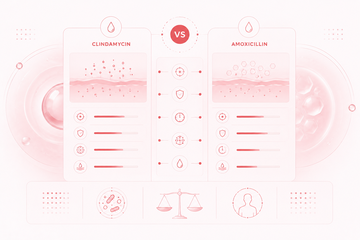
Clindamycin vs Amoxicillin comparison

Clindamycin vs Amoxicillin is commonly described as a comparison between two structurally and mechanistically different antibacterial agents. Clindamycin belongs to the lincosamide class and primarily inhibits bacterial protein synthesis through binding to the 50S ribosomal subunit. Amoxicillin belongs to the penicillin family of beta-lactam antibiotics and interferes with bacterial cell-wall synthesis through interaction with penicillin-binding proteins. The distinction between ribosomal inhibition and cell-wall inhibition provides a foundational pharmacology framework for understanding their antibacterial behavior.

Their antimicrobial profiles also differ in relation to bacterial species and resistance mechanisms. Clindamycin is often discussed in relation to susceptible gram-positive organisms and anaerobic bacteria, while Amoxicillin has activity against selected gram-positive and gram-negative organisms subject to susceptibility. Staphylococcal resistance can involve target modification and inducible resistance mechanisms relevant to Clindamycin, while beta-lactamase production and altered penicillin-binding proteins can influence Amoxicillin susceptibility. These patterns may be considered when examining MRSA, MSSA, streptococcal, or polymicrobial infections.

An antibiotic comparison does not reduce these agents to a universal hierarchy. Clinicians may evaluate pathogen identity, laboratory susceptibility, resistance phenotype, infection site, microbial burden, tissue penetration, pharmacokinetics, and host factors as separate dimensions. Respiratory, dental, skin, wound, and soft tissue infections can present different microbial environments. Related contexts include abscess, cellulitis, and infected wounds, where bacterial ecology and tissue characteristics may affect interpretation of pharmacological properties.

Comparison feature Clindamycin Amoxicillin
Antibiotic class Lincosamide Aminopenicillin beta-lactam
Primary molecular target 50S ribosomal subunit Penicillin-binding proteins involved in cell-wall synthesis
Core pharmacological action Inhibits bacterial protein synthesis Interferes with bacterial cell-wall synthesis
Resistance considerations May include target modification and inducible resistance May include beta-lactamase production and altered target proteins

Pharmacology Differences

The pharmacology differences between Clindamycin and Amoxicillin begin with their molecular targets. Clindamycin binds to the bacterial 50S ribosomal subunit and alters peptide synthesis, producing a pharmacodynamic effect distinct from beta-lactam activity. Amoxicillin binds to penicillin-binding proteins and disrupts the processes required for bacterial cell-wall construction. Because these targets occupy different biological pathways, resistance mechanisms, pharmacodynamic characteristics, and relationships between antimicrobial exposure and bacterial susceptibility also differ.

Pharmacokinetics provides another comparison dimension. Clindamycin undergoes substantial hepatic metabolism and has distribution characteristics associated with its physicochemical properties, while Amoxicillin is predominantly associated with renal elimination. Differences in absorption, distribution, metabolism, protein binding, and clearance can influence systemic exposure and tissue concentrations. These pharmacokinetic characteristics are separate from microbiological susceptibility, which describes the organism's response to an antimicrobial under defined laboratory conditions. The two domains are often discussed together but should not be treated as equivalent.

Additional pharmacological distinctions include adverse-effect profiles, drug interactions, allergy considerations, contraindications, and formulation characteristics. Information concerning side effects, allergy, and contraindications represents a separate component of antibiotic comparison. Clinicians may evaluate these characteristics alongside organism identity, microbial burden, inflammatory response, tissue compartment, and susceptibility data. Thus, Clindamycin vs Amoxicillin comparison is multidimensional, combining molecular pharmacology with microbiology and anatomical context rather than relying on a single property.

Pharmacology dimension Clindamycin Amoxicillin
Molecular target 50S ribosomal subunit Penicillin-binding proteins
Mechanism Protein synthesis inhibition Cell-wall synthesis inhibition
Major elimination context Predominantly hepatic metabolism and biliary pathways Predominantly renal elimination
Resistance mechanisms Target modification and inducible resistance can be relevant Beta-lactamase production and altered binding proteins can be relevant

Spectrum Differences

Spectrum differences are central to the Clindamycin vs Amoxicillin comparison because each agent interacts with a different range of susceptible bacterial organisms. Clindamycin is commonly described as having activity against susceptible gram-positive organisms and many anaerobic bacteria, while its activity against gram-negative aerobic organisms is limited. Amoxicillin has activity against selected gram-positive and gram-negative organisms, but susceptibility may be reduced by beta-lactamase production or other resistance mechanisms. These distinctions make organism identification important within any bacterial infection overview.

Gram-positive organisms such as susceptible streptococci and staphylococci can demonstrate different susceptibility patterns depending on resistance phenotype. The distinction between MRSA and MSSA illustrates how species-level classification alone does not describe antimicrobial susceptibility. Clindamycin resistance may involve methylation of the ribosomal target and inducible resistance patterns, while Amoxicillin susceptibility can be altered by beta-lactamase enzymes and changes in penicillin-binding proteins. Gram-negative organisms may present additional permeability and outer-membrane barriers.

Anaerobic bacteria represent another important spectrum consideration, particularly in polymicrobial environments. Dental and soft tissue infections can contain mixed microbial communities with aerobic and anaerobic components. Conditions such as soft tissue infection, abscess, and infected wounds may therefore have complex microbial profiles. Clinicians may evaluate susceptibility testing, local resistance surveillance, microbial burden, infection anatomy, and documented pathogen identity when interpreting the spectrum of either agent.

Spectrum category Clindamycin context Amoxicillin context
Gram-positive organisms Activity includes susceptible organisms in relevant species Activity includes selected susceptible organisms
Gram-negative aerobic organisms Generally limited activity Activity varies by organism and resistance mechanism
Anaerobic bacteria Commonly associated with activity against susceptible anaerobes Activity varies among organisms and beta-lactamase phenotypes
Staphylococcal resistance Inducible or constitutive resistance can affect susceptibility Beta-lactamase and altered target mechanisms can affect susceptibility

Infection Context

The infectious-disease context determines how Clindamycin vs Amoxicillin characteristics are interpreted. Respiratory infections may involve streptococci and other respiratory bacteria, while skin and soft tissue infections may involve staphylococci, streptococci, or polymicrobial communities. Dental infections can include oral streptococci, anaerobic organisms, and other mixed flora. A bacterial infection overview therefore requires attention to the anatomical site, microbial ecology, tissue environment, and documented or suspected susceptibility rather than considering antibiotic class in isolation.

A localized abscess can contain concentrated purulence and a relatively complex microbial population, whereas cellulitis is more commonly associated with bacterial involvement in tissue planes without a discrete purulent cavity. Abscess and cellulitis therefore represent different infection contexts even when both involve inflammatory response and bacterial activity. Similarly, skin infection and soft tissue infection can vary in microbial burden, tissue depth, oxygen availability, and resistance phenotype.

The comparison becomes particularly nuanced when resistance mechanisms or polymicrobial infection are present. Clindamycin may be considered within discussions of susceptible gram-positive and anaerobic organisms, whereas Amoxicillin may be considered within discussions of susceptible organisms covered by its beta-lactam spectrum. Neither description establishes a clinical recommendation. Clinicians may evaluate microbiological data, local susceptibility patterns, infection anatomy, tissue penetration, inflammatory findings, microbial burden, and host characteristics as separate components of infectious-disease interpretation.

Infection context Potential microbial pattern Relevant comparison factor
Respiratory infection Streptococci and other respiratory bacteria Species-specific susceptibility
Skin or soft tissue infection Staphylococci, streptococci, or mixed organisms Spectrum and resistance phenotype
Dental infection Oral streptococci and anaerobic or mixed flora Polymicrobial coverage and susceptibility
Abscess Purulent, potentially polymicrobial bacterial community Microbial burden and tissue environment

Neutral Dosing Concepts

Dosing concepts in the Clindamycin vs Amoxicillin comparison concern the relationship between pharmacokinetic exposure, pharmacodynamic activity, organism susceptibility, formulation, and infection-site characteristics. Clindamycin and Amoxicillin have different molecular properties and disposition pathways, so their dosing frameworks are not interchangeable. Clindamycin pharmacodynamics are commonly discussed in relation to antimicrobial exposure and bacterial susceptibility, while beta-lactam pharmacodynamics are often characterized through exposure relative to the organism's susceptibility threshold.

Pharmacokinetic interpretation includes absorption, distribution, metabolism, elimination, protein binding, and tissue penetration. Clindamycin is substantially metabolized through hepatic pathways, whereas Amoxicillin is predominantly eliminated through the kidneys. Physiological variables may therefore alter systemic exposure differently between the two agents. Infection-site factors such as inflammatory edema, tissue perfusion, microbial burden, necrosis, and anatomical compartment can also influence the relationship between circulating concentrations and local antimicrobial exposure.

General information about soft tissue dosing concepts, bone dosing concepts, joint dosing concepts, and dental dosing concepts should be distinguished from individualized prescribing. Formulations such as capsules, gel, cream, and solution can have different pharmacokinetic or local-delivery characteristics. Clinicians may evaluate exposure concepts together with susceptibility, allergy, contraindications, and infection-site factors without reducing the comparison to numerical dosing instructions.

Dosing concept Clindamycin context Amoxicillin context
Pharmacokinetic profile Substantial hepatic metabolism with tissue distribution Predominantly renal elimination
Pharmacodynamic framework Exposure related to antibacterial activity against susceptible organisms Beta-lactam exposure commonly related to time relative to susceptibility threshold
Formulation Available formulations may differ in absorption or local exposure Formulation can influence administration and systemic exposure
Infection-site influence Tissue penetration and inflammatory environment can affect interpretation Perfusion, inflammation, and tissue compartment can affect exposure

Clinical Interpretation Factors

Clinical interpretation of Clindamycin vs Amoxicillin integrates microbiology, pharmacology, anatomy, and host factors. Organism identity and susceptibility testing provide a microbiological foundation, while resistance phenotype can substantially modify the relevance of a drug's nominal spectrum. Staphylococcal classification illustrates this distinction: MRSA and MSSA are not interchangeable susceptibility categories. Clindamycin may be affected by inducible resistance mechanisms, while Amoxicillin susceptibility can be affected by beta-lactamase production and altered penicillin-binding proteins.

Microbial burden and tissue environment add additional dimensions. Polymicrobial infections can contain organisms with different susceptibility profiles, while biofilm-associated communities may exhibit altered antimicrobial behavior compared with planktonic bacterial populations. Inflammatory response, edema, tissue perfusion, necrosis, and anatomical barriers can influence local exposure. Conditions such as folliculitis, impetigo, and infected wounds can therefore represent different infectious-disease contexts despite overlapping bacterial classifications.

Host factors are another component of pharmacological interpretation. Renal and hepatic function, previous antimicrobial exposure, documented allergies, contraindications, concurrent medications, and adverse-effect considerations may alter the overall context. Clinicians may evaluate these variables separately from the intrinsic spectrum of Clindamycin or Amoxicillin. The resulting framework emphasizes that antibiotic comparison is a structured assessment of mechanism, susceptibility, pharmacokinetics, microbial burden, tissue context, and host characteristics rather than a simple ranking between two agents.

Interpretation factor Clindamycin relevance Amoxicillin relevance
Resistance phenotype Inducible and constitutive resistance may alter susceptibility Beta-lactamase production and target changes may alter susceptibility
Microbial burden May influence pharmacodynamic interpretation in complex infections May influence exposure and bacterial response in complex infections
Tissue environment Distribution and local conditions influence interpretation Tissue penetration and perfusion influence interpretation
Host factors Hepatic function, interactions, allergy, and adverse-effect profile may matter Renal function, allergy, interactions, and adverse-effect profile may matter

Frequently Asked Questions

Clindamycin vs Amoxicillin comparison refers to evaluating two antibacterial agents with different pharmacological classes and molecular targets. Clindamycin is a lincosamide that inhibits bacterial protein synthesis, whereas Amoxicillin is a beta-lactam that interferes with bacterial cell-wall synthesis. The comparison commonly includes spectrum, susceptibility, resistance mechanisms, pharmacokinetics, pharmacodynamics, and infection-site context.

A bacterial infection overview provides the microbiological context needed to interpret Clindamycin and Amoxicillin. It may include organism identity, gram-positive or gram-negative classification, anaerobic involvement, microbial burden, polymicrobial composition, and resistance phenotype. Susceptibility patterns are especially important because the presence of a bacterial species does not by itself establish susceptibility to either antimicrobial agent.

Clindamycin is commonly described as having activity against susceptible gram-positive organisms and many anaerobic bacteria, with limited activity against aerobic gram-negative organisms. Amoxicillin has activity against selected gram-positive and gram-negative organisms, although beta-lactamase production and other resistance mechanisms can alter susceptibility. Therefore, spectrum comparison depends on the organism, resistance phenotype, and microbial environment.

Gram-positive and gram-negative organisms differ in cell-envelope structure, permeability, resistance mechanisms, and susceptibility patterns. Clindamycin is primarily discussed in relation to susceptible gram-positive organisms and anaerobic bacteria, whereas Amoxicillin has activity against selected gram-positive and gram-negative organisms. These distinctions mean that bacterial classification can provide useful context, but laboratory susceptibility remains important for interpreting antimicrobial activity.

Susceptibility patterns describe how particular bacterial organisms respond to antimicrobial agents under defined laboratory conditions. Clindamycin susceptibility can be influenced by ribosomal target modification and inducible resistance, particularly among staphylococci. Amoxicillin susceptibility can be altered by beta-lactamase production and changes in penicillin-binding proteins. Local resistance patterns and organism-specific laboratory data can therefore materially change the pharmacological interpretation.

Clindamycin and Amoxicillin differ primarily in molecular target, drug class, pharmacodynamics, metabolism, and resistance mechanisms. Clindamycin inhibits bacterial protein synthesis through the 50S ribosomal subunit and undergoes substantial hepatic metabolism. Amoxicillin inhibits bacterial cell-wall synthesis through penicillin-binding proteins and is predominantly associated with renal elimination. Their pharmacokinetic and pharmacodynamic characteristics therefore require separate interpretation.

Infection context influences interpretation because bacterial species, microbial burden, tissue depth, anatomical compartment, oxygen availability, inflammation, and polymicrobial composition vary across infections. A respiratory infection may involve a different microbial profile from a skin, wound, dental, or soft tissue infection. Clindamycin and Amoxicillin therefore cannot be compared meaningfully without considering the organisms and anatomical environment involved.

Infectious-disease classification organizes infections according to factors such as anatomical site, causative organism, gram classification, resistance phenotype, tissue involvement, and microbial ecology. Clindamycin vs Amoxicillin comparison fits within this framework because antibacterial spectrum and susceptibility depend on these classifications. The same broad infection category can contain organisms with substantially different resistance patterns, making microbiological classification central to pharmacological interpretation.